 Neuroscience
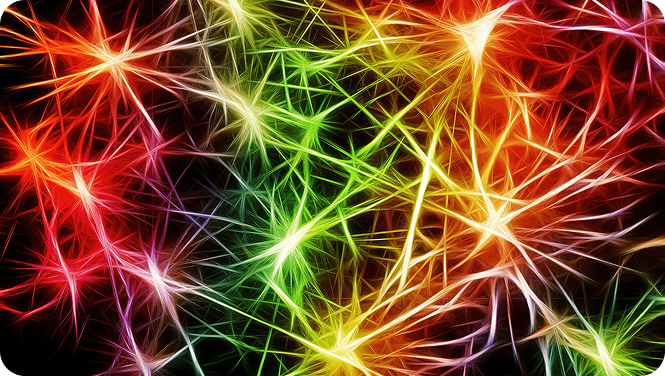
3D neuron reconstructions from the EyeWire neuroscience game and research project.
EyeWire is a game to map the brain from Dr. Sebastian Seung's Computational Neuroscience Lab at Princeton University. EyeWire mobilizes gamers from the around the world to create 3D reconstructions of neurons by interacting with a deep convolutional network. Seung and his team developed an artificial intelligence algorithm that allows players to reconstruct neurons from the retina in volumetric segments by scrolling through a cube (measuring about 4.5 microns per side or ~10x smaller than the average width of a human hair) and map branches of a neuron from one side of a cube to the other, like a 3D puzzle.
EyeWire is played by over 150,000 people from 145 countries. Sign up to try it for yourself!
Read more about EyeWire on the EyeWire Blog , and check out the research paper published in Nature , where authorship was given to the EyeWire player community. Learn about the Connectome in this TED talk by Dr. Sebastian Seung , founder of EyeWire.
EyeWire is jointly operated by a nonprofit named WiredDifferently , and by the Seung Lab at Princeton University.
Neuroscience